

taqath
October 3, 2026
Missed UAE Corporate Tax Filing Deadline?
Missed UAE Corporate Tax Filing Deadline?
What to Do After 30 September 2026
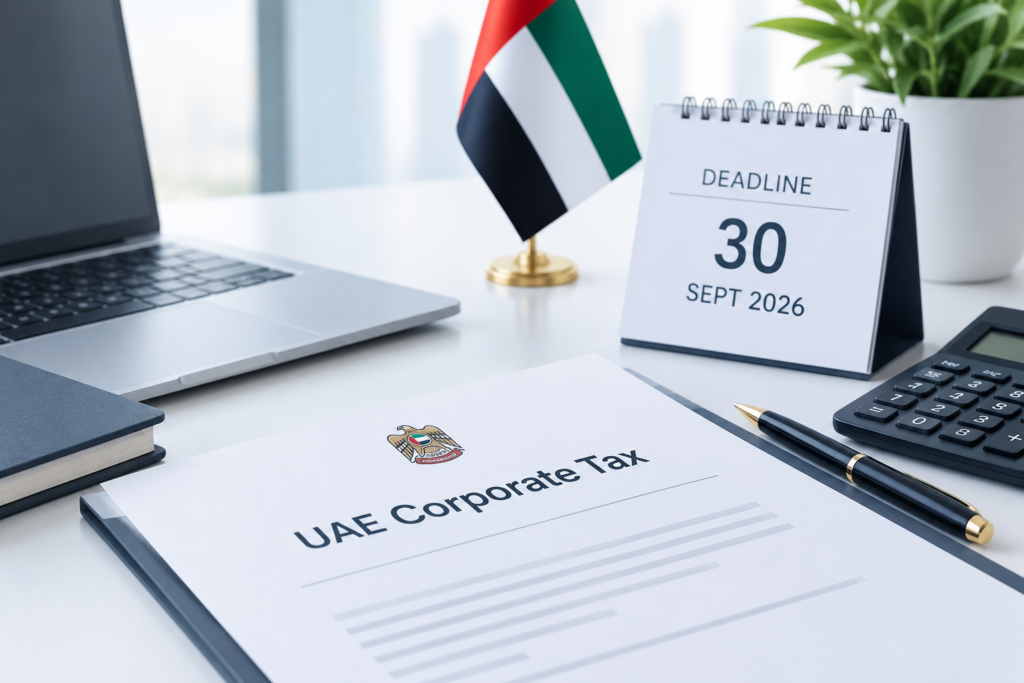
The UAE Corporate Tax system is now a practical compliance requirement for businesses. For many companies with a financial year ending on 31 December 2025, the key filing and payment deadline was 30 September 2026.
If your business has missed this deadline, the most important step is not to delay further. Late filing, late payment, incomplete records, and incorrect tax return preparation can increase compliance risk and may lead to administrative penalties.
This guide explains what UAE businesses should do immediately after missing the Corporate Tax filing deadline, how to organise the required information, and why professional support can help reduce errors and delays.
Who Was Affected by the 30 September 2026 Deadline?
The 30 September 2026 deadline applied to taxable persons whose Corporate Tax period ended on 31 December 2025. These businesses were required to file their Corporate Tax Return and pay any Corporate Tax due within the applicable timeframe.
This includes companies that are registered for Corporate Tax and businesses that may be eligible for Small Business Relief. Even where no Corporate Tax is payable, filing obligations may still apply.
Many businesses misunderstand this point. A company may have low profit, no profit, or even a loss, but it may still need to complete its Corporate Tax filing requirement.
What Happens If the Deadline Is Missed?
If the deadline is missed, the business should act quickly. The longer the delay continues, the higher the risk of penalties, compliance issues, and complications with future tax filings.
The Federal Tax Authority has stated that late submission of a Corporate Tax Return or delay in settling Corporate Tax payable can result in administrative penalties. The penalty for late submission is AED 500 for each month, or part of a month, during the first twelve months. From the thirteenth month onwards, the penalty increases to AED 1,000 for each month, or part of a month.
This means even a short delay should be treated seriously. Businesses should not wait for reminders or notices before taking action.
Immediate Steps to Take After Missing the Deadline
1. Check Your Corporate Tax Registration Status
First, confirm whether your business is already registered for Corporate Tax. Log in to EmaraTax and check the Corporate Tax registration, Tax Registration Number, tax period, and filing status.
If your business is not yet registered but is required to register, you should regularise the position as soon as possible.
2. Identify the Correct Tax Period
Before filing, confirm the company’s first tax period and financial year-end. This is important because the filing deadline depends on the tax period.
For businesses with a 31 December 2025 year-end, the filing and payment deadline was 30 September 2026. However, businesses with different financial year-ends may have different filing deadlines.
3. Prepare the Accounting Records
The Corporate Tax Return should be based on accurate accounting records. Before filing, review the following:
- Sales and revenue records
- Purchase and expense records
- Bank statements
- Loan and owner transaction records
- Fixed asset details
- Payroll and staff cost records
- VAT return reconciliation
- Receivables and payables
- Related party transactions, if any
- Opening balances and prior year adjustments
Incomplete bookkeeping is one of the main reasons businesses delay Corporate Tax filing. If the accounts are not updated, the return may be filed incorrectly.
4. Review VAT and Accounting Consistency
Businesses registered for VAT should compare accounting records with VAT returns already submitted. Turnover, taxable supplies, input VAT, output VAT, and expense classification should be reviewed.
Differences between VAT records and accounting records should be explained and corrected where necessary.
5. Calculate Taxable Income Carefully
Corporate Tax is not always calculated simply from the accounting profit. Adjustments may be required based on UAE Corporate Tax rules.
Businesses should review deductible expenses, non-deductible expenses, exempt income, reliefs, losses, and any special tax treatment that may apply.
6. Check Small Business Relief Eligibility
Some businesses may be eligible for Small Business Relief, subject to the relevant conditions. However, eligibility should be checked carefully before claiming it.
A business should not assume it qualifies without reviewing revenue, tax period, ownership structure, and other applicable conditions.
7. File the Return as Soon as Possible
Once the records are ready and the tax position is reviewed, the Corporate Tax Return should be filed through EmaraTax without further delay.
If Corporate Tax is payable, payment should also be made promptly to reduce further compliance exposure.

Common Mistakes to Avoid
Businesses that missed the deadline should avoid rushing the filing without proper review. A fast but incorrect return can create future problems.
Avoid these common mistakes:
- Filing without updated bookkeeping
- Ignoring bank reconciliation differences
- Not matching VAT returns with accounting records
- Claiming Small Business Relief without checking eligibility
- Leaving owner drawings or related-party balances unexplained
- Treating all expenses as deductible without review
- Not maintaining supporting documents
- Assuming no profit means no filing requirement
- Waiting for an FTA notice before taking action
What Records Should Businesses Keep?
- Financial statements
- General ledger
- Sales invoices
- Purchase invoices
- Bank statements
- Payment vouchers
- Receipt vouchers
- Payroll records
- Fixed asset register
- Loan documents
- Contracts and agreements
- VAT return workings
- Corporate Tax computation files
How Taqath Can Help
Taqath Corporate Services Providers supports UAE businesses with practical Corporate Tax and accounting compliance services.
Our team can help with:
- Corporate Tax registration review
- Corporate Tax return preparation
- Bookkeeping and ledger cleanup
- VAT and accounting reconciliation
- Financial statement preparation
- Small Business Relief review
- EmaraTax filing support
- Penalty and compliance position review
- Monthly accounting and reporting
- Accounting software setup and data correction
Our approach is practical. We first review the business records, identify gaps, correct accounting issues, reconcile balances, and then proceed with tax filing support.
Why Businesses Should Act Immediately
Missing the Corporate Tax filing deadline should not be ignored. The best approach is to correct the position quickly and maintain proper records going forward.
Delaying further may increase penalty exposure, create pressure during future filing periods, and make it harder to explain records later.
The priority is simple.
Update the accounts → Review the tax position → File the return → Pay any tax due → Maintain proper records.
Conclusion
The UAE Corporate Tax filing deadline is now an active compliance responsibility for businesses. If your company missed the 30 September 2026 deadline, you should not wait.
The sooner the records are reviewed and the return is filed, the better the business can manage its compliance position.
Taqath Corporate Services Providers can assist with Corporate Tax filing, bookkeeping cleanup, VAT reconciliation, accounting software support, and ongoing compliance management for UAE businesses.
TAQATH SERVICES
Call to Action
Missed your UAE Corporate Tax filing deadline?
Contact Taqath Corporate Services Providers today for Corporate Tax filing support, accounting review, bookkeeping cleanup, and EmaraTax compliance assistance.
Taqath Corporate Services Providers

Accounting & Bookkeeping
Accounting & Bookkeeping services provide accurate financial tracking, helping businesses manage income, expenses, payroll, and taxes, ensuring compliance.

VAT Services
Value Added Tax (VAT) compliance is essential for businesses operating in the UAE. Our VAT Services help you stay compliant with Federal Tax Authority (FTA) regulations.

Corporate Tax Services
Stay compliant with the UAE Corporate Tax Law while minimizing risks and ensuring smooth tax operations. Our Corporate Tax Services are designed to help businesses understand.

Business Setup
Setting up a business in the UAE doesn’t have to be complex. At Taqath, we provide complete business setup solutions including mainland, free zone, and offshore company formation.

Accounting Software Support
Taqath Corporate Services Providers offers Manager.io setup and support to streamline your business accounting. We configure your chart of accounts, VAT structure, customer and supplier records, and financial reporting to suit UAE business requirements and compliance needs.
Frequently asked question
For taxable persons whose tax period ended on 31 December 2025, the Corporate Tax Return and Corporate Tax payment deadline was 30 September 2026.
You should immediately review your accounting records, confirm your tax period, prepare the Corporate Tax computation, file the return through EmaraTax, and pay any Corporate Tax due.
In many cases, yes. A company may still have a filing obligation even if it has no profit or no Corporate Tax payable.
Yes. Taqath can help update accounts, reconcile bank statements, review VAT records, prepare financial statements, and support Corporate Tax filing.
Yes. Late filing and late payment may result in administrative penalties. Businesses should act quickly to reduce further delay.